Food policy monitoring in the Near East and North Africa region | Digital solutions for small-scale farmers in the NENA region: opportunities and challenges
In the second quarter of 2025, the food security situation in the Near East and North Africa (NENA) region remained fragile due to ongoing conflict, relatively high food prices, and volatile agricultural production. While global food commodity prices showed marginal signs of stabilization, regional inflationary pressures and constrained access to food continued to affect vulnerable […]
Technology for Disaster Risk Reduction
This special report examines the past, present and future applications of technology in advancing disaster risk reduction (DRR) efforts. By providing detailed explanations, definitions and regional case studies, this report showcases how various technologies have helped bridge critical gaps in data gathering, data processing and disaster risk modelling related to multiple hazards and at different […]
Mapping affordable and transferrable climate-smart technologies for smallholder farmers
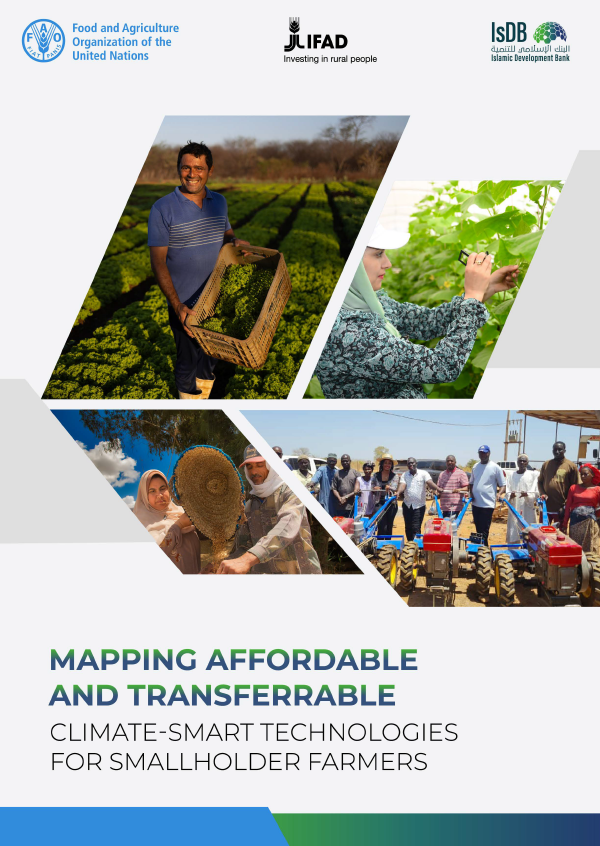
In response to the pressing need for innovative solutions to address food security challenges, a tripartite cooperation agreement between FAO’s Regional Office for the Near East and North Africa, the International Fund for Agricultural Development (IFAD) and the Islamic Development Bank (IsDB), initiated a comprehensive “Mapping exercise of affordable and transferrable food security related technologies.” […]
The role of innovation and digitalization in the sustainable use of natural resources to accelerate the implementation of climate-resilient and low-emission pathways in agrifood systems – ERC/24/2
The natural resources that contribute to global agrifood systems are at risk of depletion and degradation. By 2050, the agriculture sector will need to produce 56 percent more food compared to 2010 to feed a growing global population,1,2 while crop yield could decrease by up to 30 percent.3,4 Land degradation, desertification, drought and land abandonment […]
A Systems Approach for Disaster Risk Reduction: Exploring the Nexus of Energy, Food, and Human Mobility in the Northern Countries of Central America
Globally, disasters and their impacts have been characterized by increasing frequency and changing patterns. Global warming effects, including climate change, have exacerbated the severity and frequency of hydrometeorological and oceanographic, and other risk factors or drivers, such as population growth, urbanization, limited access to resources, inadequate infrastructure, and prevailing structural development conditions, putting additional lives […]
Water–energy–food–health nexus in Lebanon
This study used a water–energy–food system-of-systems assessment to evaluate the sustainability of the Mediterranean diet in Lebanon. The specific aims were to: 1) identify and quantify the critical interconnections between water, energy and food systems in Lebanon; 2) develop a nexus framework to assess the trade-offs associated with adopting interventions within current water, energy and […]
Water and Youth Engagement Strategy 2023-2028
Youth make up a large portion of the world’s population, as well as the UfM member states population. Nearly 15.5% of the world’s population is between the ages of 15-24.4 Within the UfM member states, a similar population average of 12.8% of the total population are between the age range of 15-24.5 If we consider […]
Development of Framework for the Governance of the Water, Energy, Food and Environment (WEFE) Nexus in Jordan: Governance and institutional frameworks analysis and global lessons learned
Water, energy, and food systems are tightly interconnected, and the way in which they are managed has direct impacts on the environment and eco-systems in which they exist. Water, energy, and food security are critical for economic growth and human development. Globally, water demand is expected to increase by 1% each year for the next […]
SDSN USA Zero Hunger Pathways Project Submission for the White House Conference on Hunger, Nutrition, and Health
In the 1970’s, after the U.S. significantly reduced poverty, increased economic opportunity, and dramatically expanded federal nutrition safety net programs, the nation almost entirely ended domestic hunger. In the succeeding decades, as poverty increased, real wages decreased, and safety net programs were scaled back, hunger and food insecurity in America soared. Therefore, in 2022 hunger […]
Water and Youth Opportunities in the Mediterranean. Union for the Mediterranean, Barcelona.
In response to the gap of connecting youth in the Mediterranean to jobs post-graduation, compounded by the challenges of COVID-19 on the job market worldwide, this report includes a review of water sector job trends amidst COVID-19 and opportunities for Mediterranean youth employment in the sector. A review of government stimulus packages supporting the water […]