From Data to Decisions: Water-Energy-Food-Environment (WEFE) Nexus Modeling Under Changing Climate
Transforming data into actionable insights is crucial for building resilient and sustainable water, energy, food, and environmental systems. However, the accelerating impacts of climate change are reshaping the dynamics of WEFE systems, intensifying resource interdependencies, and challenging conventional resource planning approaches. To navigate this complexity, decision-makers increasingly need integrated modeling frameworks that reflect cross-sectoral linkages […]
Fifty years of excellence in water resources research: insights from the most cited articles per decade published in Water International
It has been emphasized since its inception that IWRA is established not to duplicate the functions of many existing organizations but to supplement their activities and to fill in the interdisciplinary voids that occur in the professional field of water resources. The concept of WATER INTERNATIONAL is therefore to provide broad knowledge and information on […]
Challenges and future actions on water‐economy‐ecology‐societynexus under changing environment

View full journal article: https://onlinelibrary.wiley.com/doi/epdf/10.1002/rvr2.111
Predictive simulation of the water-energy-food nexus for the City of Cape Town
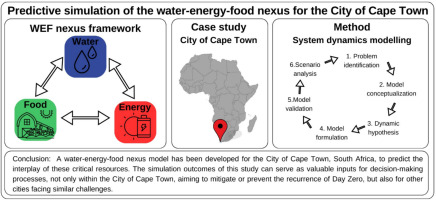
The City of Cape Town (CoCT), South Africa faced a critical situation between 2015 and 2018 in which the municipal water supply was almost completely exhausted. This situation, commonly referred to as Day Zero in South Africa emanated from a decline in rainfall, resulting in one of the most severe droughts in history. The crisis was also aggravated by […]
A Systems Approach for Disaster Risk Reduction: Exploring the Nexus of Energy, Food, and Human Mobility in the Northern Countries of Central America
Globally, disasters and their impacts have been characterized by increasing frequency and changing patterns. Global warming effects, including climate change, have exacerbated the severity and frequency of hydrometeorological and oceanographic, and other risk factors or drivers, such as population growth, urbanization, limited access to resources, inadequate infrastructure, and prevailing structural development conditions, putting additional lives […]
Water–energy–food–health nexus in Lebanon
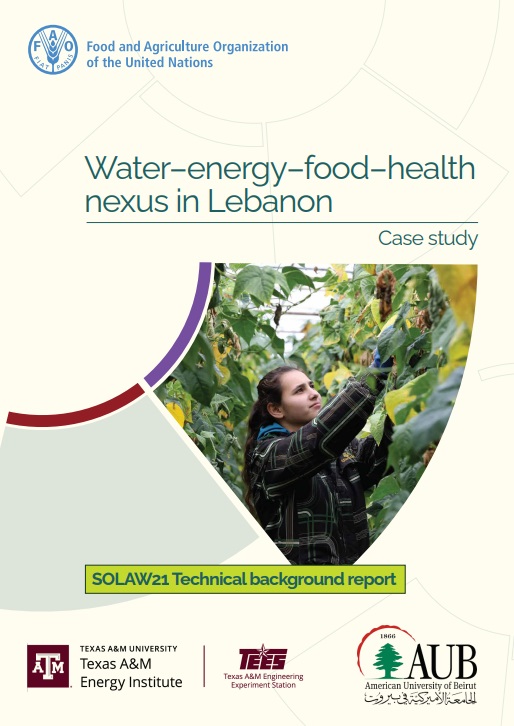
This study used a water–energy–food system-of-systems assessment to evaluate the sustainability of the Mediterranean diet in Lebanon. The specific aims were to: 1) identify and quantify the critical interconnections between water, energy and food systems in Lebanon; 2) develop a nexus framework to assess the trade-offs associated with adopting interventions within current water, energy and […]
Building resilience in fragile and conflict-affected agrifood systems through a water-energy-food nexus approach
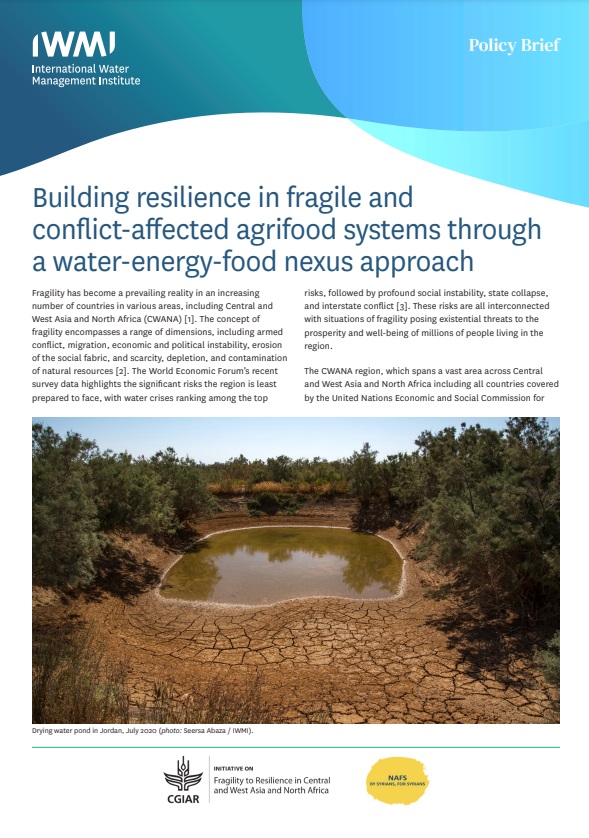
Fragility has become a prevailing reality in an increasing number of countries in various areas, including Central and West Asia and North Africa (CWANA) [1]. The concept of fragility encompasses a range of dimensions, including armed conflict, migration, economic and political instability, erosion of the social fabric, and scarcity, depletion, and contamination of natural resources […]
Examining Lebanon’s Resilience Through a Water-Energy-Food Nexus Lens
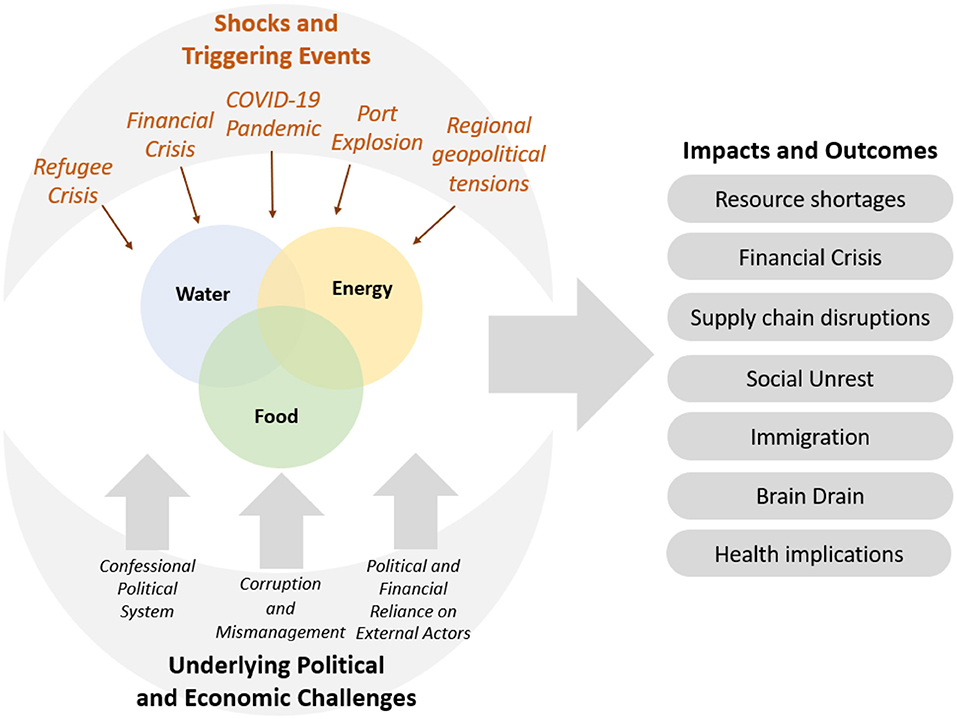
Lebanon faces a mix of underlying political and economic challenges, shocks, and triggering events that threaten the sustainability and resilience of its interconnected resource systems. The complex nature of these pressures begs for a systems approach to better understand the existing interconnections and to support the co-creation of cross-sectoral solutions to address them. This article […]
Water and Youth Engagement Strategy 2023-2028
Youth make up a large portion of the world’s population, as well as the UfM member states population. Nearly 15.5% of the world’s population is between the ages of 15-24.4 Within the UfM member states, a similar population average of 12.8% of the total population are between the age range of 15-24.5 If we consider […]
Food security under compound shocks: Can Lebanon produce its own Mediterranean food basket?

As Lebanon faces compound challenges, a looming food security crisis is rapidly approaching, much of which could be attributed to the lack of long-term planning for sustainability in its agricultural sector. The disconnect between decision-makers within the agricultural sector, and other interconnected sectors is exacerbated by the lack of integrative national platforms and methodologies for […]