The relevance and challenges in communicating the nexus

Beyond academic debates, the nexus remains a new concept for many practitioners and decision-makers, with often only a fuzzy delineation (intersection of water, energy, food, land, climate, biodiversity, health, etc.) and limited attraction. In addition, its association to ‘complexity’ often hampers the uptake in solution-oriented and sector-specific planning and management, whilst simplified approaches are discarded […]
National and International Funding for Financing Sustainable Development Goal 6: Case of Jordan

In September 2015, the United Nations General Assembly announced the list of new sustainable development goals (SDGs). These goals were put forward to guide the progress and development of member states as they plan into the future. Achieving the 17 goals described in the UN 2030 Agenda for Sustainable Development will require unprecedented levels of […]
Water-Energy-Food-Health Solutions & Innovations for Low-Carbon, Climate-Resilient Drylands

Primary resources gaps facing dryland, including access to water, food, energy, nutrition, and health care, are expected to increase with demographic, political, and climatic changes. These highly interlinked primary resources carry high risk and vulnerability. Disentangling these to better understand the complex system of systems they represent is crucial and requires multi-disciplinary work that includes […]
Water-Energy-Food Nexus: Towards Knowledge Synthesis, Action Prioritization and Revitalization of Security Debates

The Water-Energy-Food nexus (WEF nexus) has emerged as a colossal environmental debate on how to improve the sustainability and resilience of resource systems. This debate has been inclusive of different disciplines and methodological approaches that have improved our understanding of the tight interconnectedness between the resource systems, and have highlighted the need for great coordination […]
Special Issue “Urban Drainage Systems”

Increased population growth and, in many areas, uncontrolled urbanization, have led to increased imperviousness in cities across the world. This has resulted in an upsurge of urban flooding and the impairment of waterbodies due to increased stormwater flow rate, peak flow, and total volumes draining into streams, lakes, and estuaries. It has also resulted in […]
SDSN USA Zero Hunger Pathways Project Submission for the White House Conference on Hunger, Nutrition, and Health
In the 1970’s, after the U.S. significantly reduced poverty, increased economic opportunity, and dramatically expanded federal nutrition safety net programs, the nation almost entirely ended domestic hunger. In the succeeding decades, as poverty increased, real wages decreased, and safety net programs were scaled back, hunger and food insecurity in America soared. Therefore, in 2022 hunger […]
Opportunities and Challenges for Establishing a Resource Nexus Community of Science and Practice

The American Chemical Society’s Division of Environmental Chemistry symposium Toward Creating a Water-Energy-Food (WEF) Nexus Community of Practice, brought together 25 cross-disciplinary speakers in five thematic areas: 1) state of the art models and approaches, 2) WEF Nexus initiatives and case studies, 3) WEF governance and stakeholder engagement, 4) chemical processes and WEF Nexus, 5) WEF education, community, and practice. […]
Water-Energy-Food nexus: Towards knowledge synthesis, action prioritization and revitalization of security debates

The Water-Energy-Food nexus (WEF nexus) has emerged as a colossal environmental debate on how to improve the sustainability and resilience of resource systems. This debate has been inclusive of different disciplines and methodological approaches that have improved our understanding of the tight interconnectedness between the resource systems, and have highlighted the need for great coordination […]
Toward Resilient Water-Energy-Food Systems under Shocks: Understanding the Impact of Migration, Pandemics, and Natural Disasters
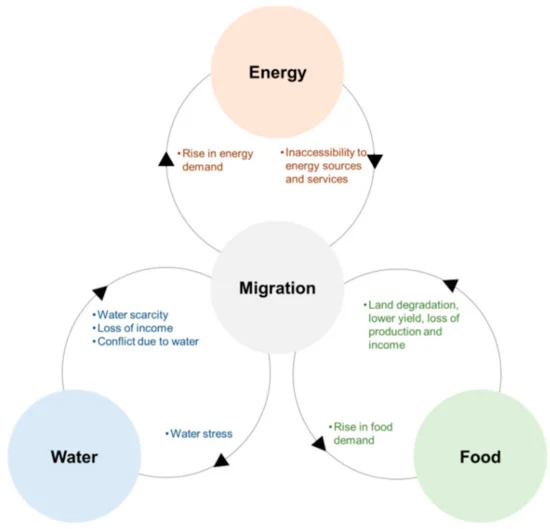
The historic pandemic faced by the international community today boldly demonstrates the complexity and interconnectedness of the resource challenges we must better understand and address in the future. Further complexity is observed when accounting for the impact of compounded shocks related to natural disasters and forced migration around the world. Effectively addressing these challenges requires […]
Evaluating the Potential of a Water-Energy-Food Nexus Approach toward the Sustainable Development of Bangladesh
In pursuit of continuous economic development, Bangladesh has undertaken long-term plans to boost its productivity in the agriculture, energy, and industrial sectors and to align with the United Nations Sustainable Development Goals (SDGs). Unless these strong interconnections and cross sectoral impacts are recognized, achievement of the future policy goals and national priorities of the concerned […]