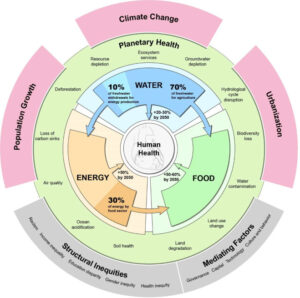
The natural resources that contribute to global agrifood systems are at risk of depletion and degradation. By 2050, the agriculture sector will need to produce 56 percent more food compared to 2010 to feed a growing global population,1,2 while crop yield could decrease by up to 30 percent.3,4 Land degradation, desertification, drought and land abandonment can lead to erosion, decreased soil quality, depletion of nutrients and drops in groundwater levels. Unhealthy soils release more greenhouse gases into the atmosphere and lead to a decrease in yields.5 The World Bank estimates that economic damage from droughts and floods in Central Asia could reach up to 1.3 percent of the gross domestic product per year. Water scarcity is also an issue, especially for the Central Asian region; by 2030, every country in Central Asia and the Caucasus other than Georgia is expected to be experiencing high or extremely high water stress.6 The lack of coordination across water, agriculture and forestry has led to a lack of integration and poor management of watersheds.7 It is urgent that the implementation of climate-resilient, low-emission and nature-positive pathways in the agrifood sector be expedited. These measures are critical for effectively addressing the spectrum of challenges the world and the Europe and Central Asia region are facing.