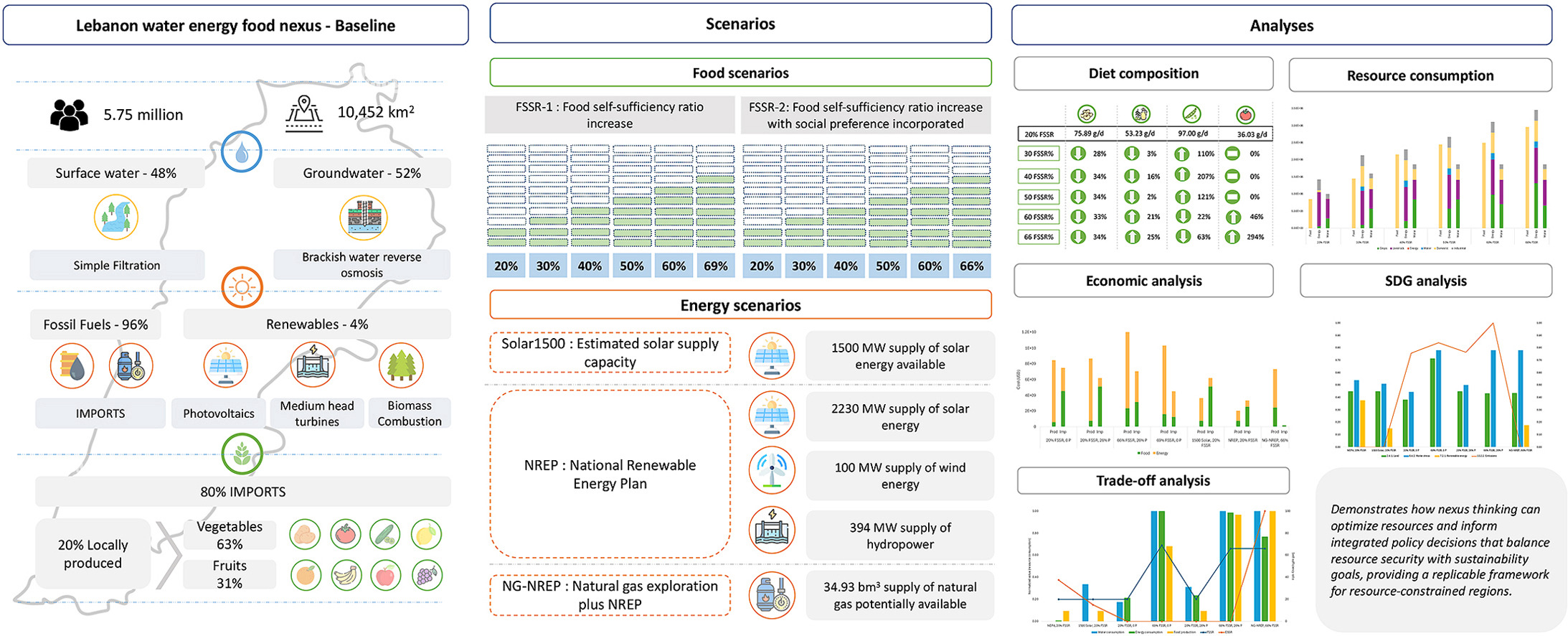
The increasing demand for resources has intensified the need for integrated management strategies that ensure resource sustainability and security. This study presents a holistic case study of the water-energy-food nexus (WEFN) in Lebanon, optimizing resource allocation to minimize water and energy consumption while maximizing food production. Leveraging a multi-objective optimization tool, this research examines scenarios reflecting Lebanon’s resource dependencies, dietary preferences, and energy constraints. The findings underscore the role of renewable energy integration and dietary shifts in enhancing resource efficiency and achieving higher self-sufficiency. By simulating policy-driven scenarios, including renewable energy targets and natural gas exploration, the study highlights trade-offs between food production, energy consumption, and environmental constraints, such as carbon and nitrogen planetary boundaries. Beyond technical optimization, the study assesses economic implications, trade-offs, and progress toward Sustainable Development Goals (SDGs). The work provides a scientific foundation for integrated resource management and policymaking in Lebanon, offering a framework for future interdisciplinary investigations and applications across developing countries.
See full post: Optimizing the water energy food nexus in Lebanon: a case study of the nexus in a developing country context – ScienceDirect