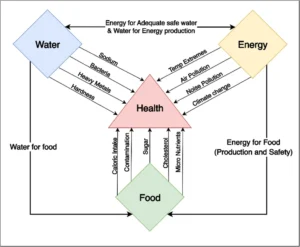
Global challenges, including disasters escalating from extreme weather, population growth, urbanization, and resource scarcity, strain critical systems. Projected supply–demand gaps by 2030, coupled with migratory crises driven by conflict, famine, and resource deprivation, threaten human security and global stability. The Arab region faces acute water, energy, and food system pressures intensified by resource limitations, population growth, migration, and climate change. A holistic, systems-based Water-Energy-Food (WEF) Nexus approach is essential for regional sustainability. This chapter examines the WEF Nexus as a strategy for resource security in the Arab context, using Jordan and Kuwait as case studies. Jordan, severely water-scarce, illustrates the impact of resource constraints, regional instability, and refugee influxes, demanding integrated management strategies. Kuwait, resource-rich but environmentally challenged, highlights energy-intensive desalination and trade-offs between energy and water sustainability. These cases emphasize the need for context-specific WEF Nexus strategies and regional collaboration. This research advances WEF Nexus studies by integrating migration as a key factor and emphasizing socio-economic and geopolitical dimensions. It advocates evidence-based policies, participatory governance, and adaptive capacity-building, offering actionable insights for policymakers and stakeholders.
https://doi.org/10.1007/978-94-024-2345-7_20