PHILOSOPHY
Solutions fail when they ignore the people they are meant to serve. I believe in building bridges across disciplines and borders, transforming complexity into clarity, and ensuring that the knowledge we produce serves real decisions and needs.
Building Bridges
Early in my career I learned that the best technical solution in the world will fail if it does not account for the people it is meant to serve. Engineering know-how alone is not sufficient. The political, social, and economic dimensions of a resource challenge are not complications to be managed after the design is done. They are the design problem.
That lesson has guided every project since. The hardest sustainability challenges do not belong to any single discipline, ministry, or sector. They live in the gaps between them: between the water agency planning on a five-year horizon and the energy sector thinking toward 2050, between the farmer facing this season’s reality and the policymaker writing next decade’s strategy, between the communities experiencing resource insecurity and the institutions with the tools to analyze it.
I strongly believe in the importance of building bridges across those gaps. Between natural and social sciences. Between research and practice. Between local knowledge and global agendas. The people closest to a problem and the people with the tools to address it are almost never in the same room. Creating that room, and making sure the right voices are in it, is itself a form of art and science that is critical to effectively addressing the complex and interconnected challenges that face us today.
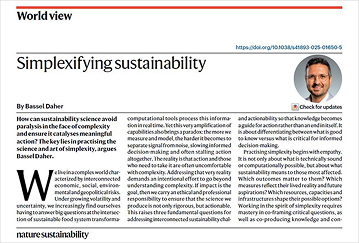
Simplexifying Sustainability
We can model entire food systems, simulate energy transitions decades into the future, and track every drop of water in a basin. Yet more data has not automatically produced better decisions. In many cases, it has produced paralysis.
I coined the term ‘simplexifying sustainability’ to name what I believe is the central challenge of our field: transforming complexity into actionable clarity without losing the interconnections that matter. This is not about dumbing things down. It is about doing the harder work of understanding what a decision-maker actually needs, when they need it, and in what form, and then building tools precise enough to meet them there.
Every model we build should be held to a simple test: does this serve the decision? Are we adding resolution, or are we adding noise? If a finding does not change what someone will do, we need to ask why we produced it.
Simplexity is not about creating simple answers to complex questions. It is about asking better questions.
Transforming Systems
Bridges connect. Simplexifying clarifies. But neither matters unless something actually changes in how resources are governed, how trade-offs are negotiated, and who has a voice in shaping the outcome.
Transformation requires more than producing better knowledge. It happens by addressing the underlying conditions that prevent collective action: the governance gaps, the missing coordination mechanisms, the financing questions no one is asking, and the dialogues that have not yet taken place. We have to catalyze those dialogues, equip the people in the room with evidence they can act on, and make sure the room itself includes the voices that are too often absent.
Everyone has a role to play in this. You do not need to be an agricultural expert to contribute to food system transformation. You do not need to be a hydrologist to care about water governance. What you need is a willingness to look beyond the boundaries of your own discipline and ask how your work connects to the systems around it.
We will not model our way to a more sustainable, resilient, and equitable future. We will build it together, one bridge, one clearer insight, and one more inclusive conversation at a time.