Trade-offs and Decision Support Tools for FEW Nexus-Oriented Management
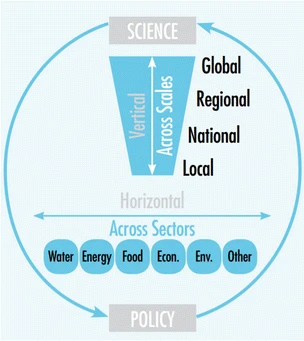
Purpose Existing assessment and decision support tools have limited application to real-world food-energy-water (FEW) Nexus challenges. Integrated assessment approaches are often discipline-specific or highly theoretical, lacking grounding in real-world FEW issues. Recent Findings FEW systems require application of integrated techniques that address multiple attributes of trade-off analyses, dynamic and disparate datasets, and difficult decision contexts. […]
Understanding the Science-Policy Gap: A Formal Principal-Agent Delegation Model
In response to the COP 21 Paris Agreement, policy shifts and interventions are going to take different shapes in different countries. It will vary depending on the types of regimes, level of development, availability of resources, and the nature of the involved stakeholders, among other things. This study introduces a Principal-Agent spatial model of delegation […]
Water-Energy-Food Nexus Framework for facilitating multi-stakeholder dialogue
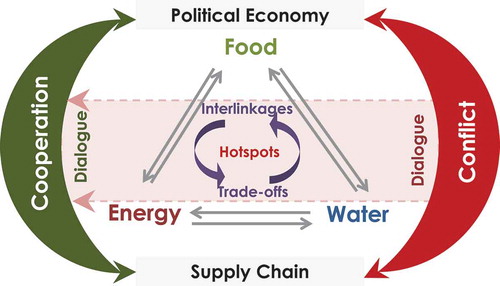
“Link to full article”
Optimizing the water energy food nexus in Lebanon: a case study of the nexus in a developing country context
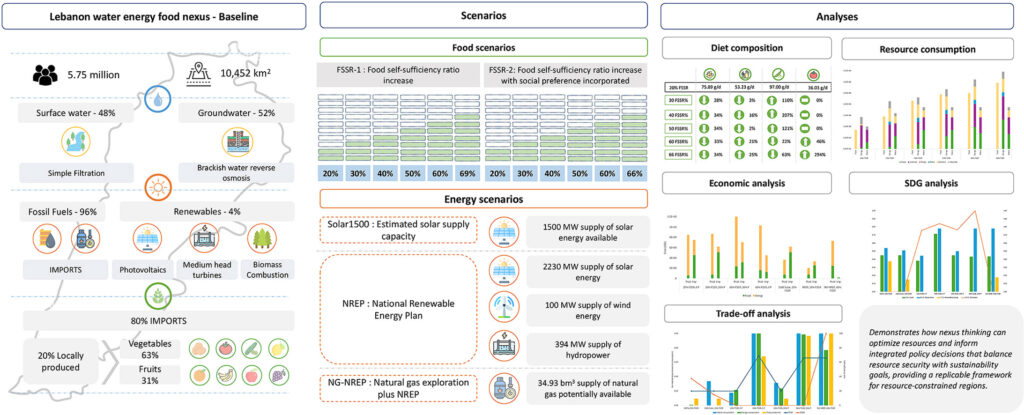
The increasing demand for resources has intensified the need for integrated management strategies that ensure resource sustainability and security. This study presents a holistic case study of the water-energy-food nexus (WEFN) in Lebanon, optimizing resource allocation to minimize water and energy consumption while maximizing food production. Leveraging a multi-objective optimization tool, this research examines scenarios […]
MENA Policy Brief Series // The WEF Nexus in the Arab Region
The WEF Nexus in the Arab Region Series is published by the League of Arab States (LAS), with technical and financial support from the Deutsche Gesellschaft fur Internationale Zusammenarbeit (GIZ). The series comprises 6 policy briefs with different focus areas on the implementation of the WEF Nexus in the MENA region. All policy briefs are […]
Water–energy–food (WEF) Nexus Tool 2.0: guiding integrative resource planning and decision-making
The paper introduces a framework and set of methodologies that define the linkages between the interconnected resources of water, energy and food, and enable explicit corresponding quantifications. The paper presents a new water–energy–food (WEF) Nexus modelling tool (WEF Nexus Tool 2.0) based on that framework which offers a common platform for scientists and policy-makers to […]
Global Sustainable Development Report 2015 (Advance Unedited Version) (GSDR 2015)
2015 will be a watershed year for sustainable development. Major international conferences – on financing for development the post-2015 development agenda, and climate change – will take momentous decisions that could, if effectively followed up, have profound implications for the future of our societies, our economies and of our planet. This is the context in […]
Renewable Energy in the Water, Energy & Food Nexus
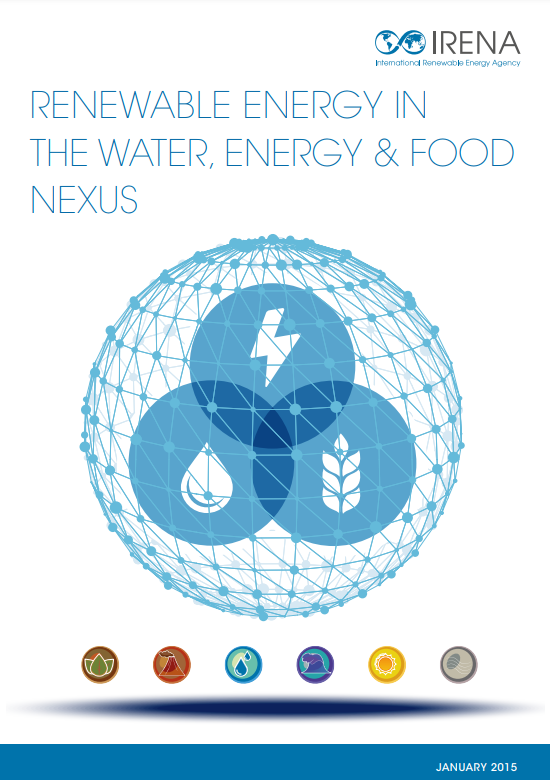
Renewable energy technologies can address trade-offs between water, energy and food, bringing substantial benefits in all three key sectors. This report from the International Renewable Energy Agency (IRENA) looks at how adopting renewables can ease trade-offs by providing less resource-intensive energy services compared to conventional energy technologies. “Link to full article”
Bridging the Water and Food Gap: The Role of the Water-Energy-Food Nexus
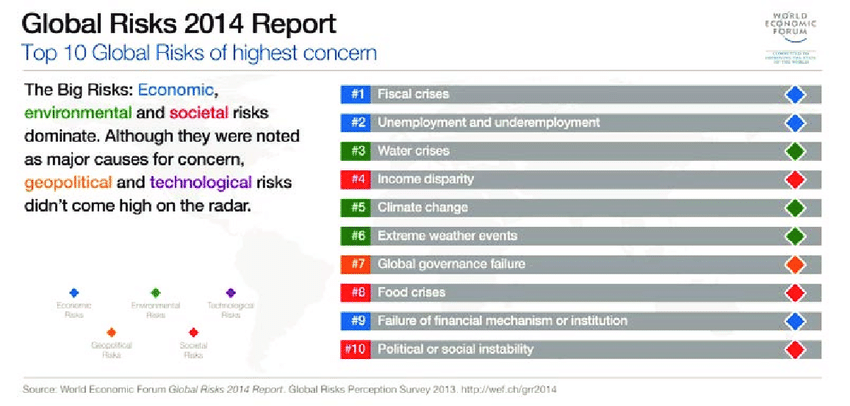
The paper introduces global resources challenges and their risks and shifts in what society defines as global securities. The paper will then introduce the water-energy-food nexus as a resource integration platform and will highlight green water as a hotspot in this nexus. Analysis will focus on the manner in which green water should be viewed […]
A Platform for Trade-off Analysis and Resource Allocation The Water-Energy-Food Nexus Tool and its Application to Qatar’s Food Security
This paper was commissioned as part of the Valuing Vital Resources research series focused on the Arab Gulf region. All countries in the region have a sensitive and interlinked relationship between oil, gas, water and food. This means policy to achieve sustainability in one area must also take into account its effects on others. Many […]