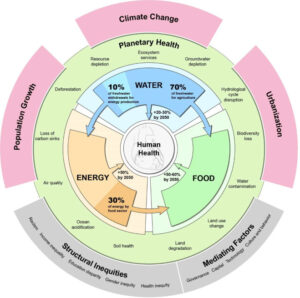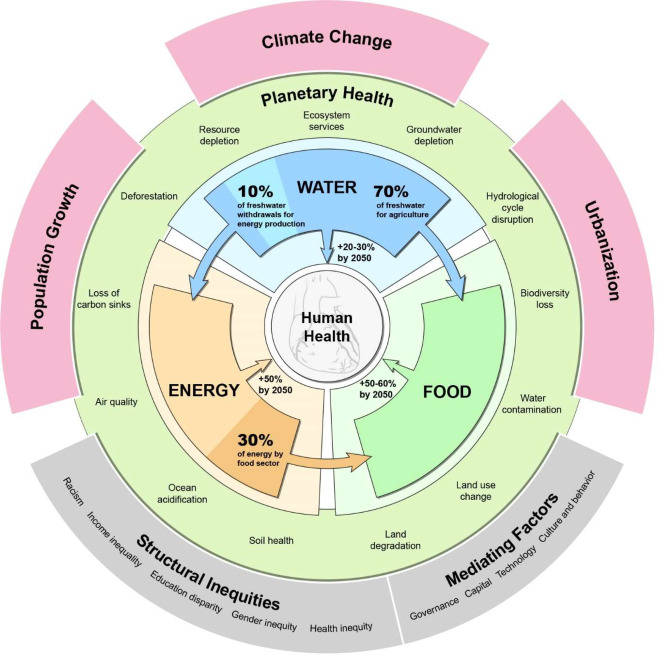
Cardiovascular health (CVH) across the life course requires stable, nurturing environments and a healthy planet. Increasing human demands on the earth’s resources destabilize our world’s ecosystems and compromising CVH. Unique research opportunities for cardiovascular researchers exist at the intersection of planetary and CVH.
Using systems thinking can reveal cardiovascular and planetary health connections and mechanisms of action. For example, meeting global demands for water, food and energy is compromising food, water and air quality at the local level, and with it, cardiovascular health. A refined understanding of the planetary-CVH interconnections is urgently needed to guide decision making. Emerging, cutting-edge research methodologies include the use of spatial indicators and urban analytics to reveal relationships between physical environments and health outcomes; advanced causal inference methods and modeling simulations; studying human exposure patterns and the exposome – the totality of environmental exposures across the life span – in a population; advances in health informatics made possible by evolving computation methods and AI; and new ways of engaging community in research. The study of planetary health is advanced by engaging a diversity of disciplines from the fields of behavioral, medical, and social sciences to earth sciences, climate change, anthropology, Indigenous studies, and engineering.
By employing a planetary health lens, systems thinking and research methodology innovations, expanded opportunities exist for CV researchers and others across a diversity of disciplines. The field will benefit from the development of a holistic research agenda, increased cross- and trans-disciplinary engagement, policy evaluation, and implementation science, to support dissemination of evidence-based findings.